

Defining a vision for AI-assisted goal setting and career growth at Dayforce
As Lead Product Designer, I led an initiative to rethink the goals feature across the Performance Management ecosystem, defining a future vision that connected individual growth, business outcomes, and AI-assisted guidance.
Company
Dayforce
Human Capital Management Software
My Role
Lead Product Designer
Duration
8 Weeks
The Problem
For many customers, goals had become little more than a compliance exercise or a place to record objectives rather than improve performance or develop employees. At the same time, AI was creating new opportunities for software to become proactive instead of passive.
I led the design strategy for a future-state vision that reimagined Goals as an intelligent platform connecting performance, learning, career development, and AI coaching to help organizations build higher-performing teams.
How I Contributed
As Lead Product Designer, I worked hands-on across every phase of the project, contributing directly to research, design, and strategy, while coaching a senior designer.
My responsibilities included:
- Defined and conducted research strategy
- Synthesized customer insights, data, and secondary research
- Facilitated cross-functional workshops and aligned stakeholders
- Created wireframes, concepts, and high-fidelity designs
- Built prototypes, defined future-state experience, and led presentations
Who I worked With
Design
Sr Product Designer
Product
Director of Product Management
Product Managers
Engineering
Sr Software Engineering Manager
How I Shaped Product Strategy
The challenge wasn’t designing a better Goals experience—it was determining what the product should become in an era of AI. Before defining a solution, I needed evidence that could inform a long-term product strategy and justify a meaningful shift in direction.
To answer that, I focused on these strategic questions:
• What are customers ultimately trying to accomplish through performance management?
• Where are employees and managers experiencing friction across the lifecycle?
• How is the market evolving, and where is AI creating new possibilities?
• What behaviors reveal emerging needs and opportunities?
• Which opportunities have the potential to shape the future product vision?
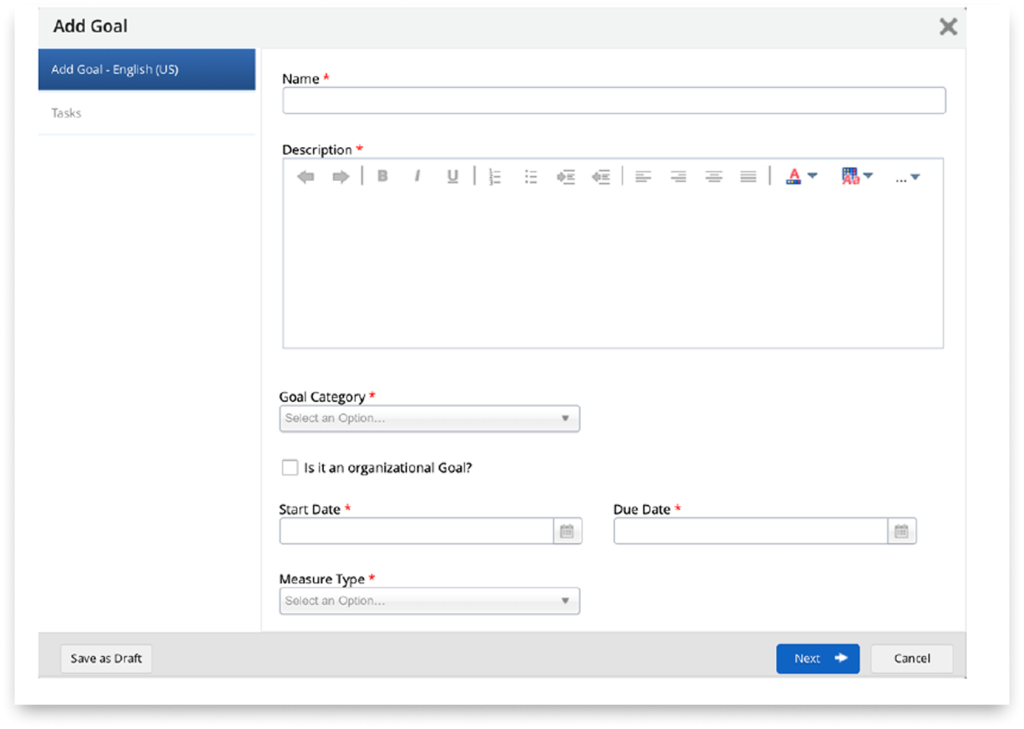
Before: goals acted more like data storage rather than a cohesive system.
My Approach
Journey Map
Mapped the jobs to be done for managers, employees, and admins using existing research to understand how goals fit into the broader performance journey
Competitor Analysis
Evaluated key competitors to understand how they structured goals at both the individual and organizational level
Secondary Research
Reviewed research, articles, and essays on goal-setting best practices within organizations to ground our direction in established theory
Customer Data
Analyzed usage data to understand how customers were actually using the existing goals module in real-world scenarios
Concept Testing
Conducted hybrid concept testing and user interviews to validate early ideas and ensure alignment with user needs
This helped us understand where goals needed to surface across the performance journey, how other platforms approached goal setting, what best practices looked like in real organizations, and how our customers were currently using the system.
These insights directly informed the design phase and allowed us to move validated concepts into concept testing with users.
How I Leveraged AI
I used AI as a strategic collaborator throughout the project, accelerating research, challenging assumptions, exploring solution spaces, and iterating on concepts more quickly. Human judgment remained central to defining the product vision, evaluating trade-offs, and shaping the final experience.
Research & Strategy
ChatGPT, Claude
Synthesized research, analyzed competitors, identified patterns, and refined the product strategy, problem statement, and Jobs to Be Done.


Ideation & UX Exploration
ChatGPT, Claude
Explored alternative concepts, interaction models, edge cases, and product directions before committing to a solution.

Rapid Prototyping
Figma Make
Generated UI concepts and interactive prototypes to quickly evaluate ideas and communicate product direction.
Enterprise Knowledge & Validation
Atlassian Rovo
Retrieved historical product context from Confluence, validated assumptions, and aligned new concepts with existing strategy and documentation.

What we learned
As we moved through research and concept testing, a few clear patterns emerged. These insights directly informed the direction of the experience.
Goal creation lacked strategic guidance
People often know what they want to achieve, but the product provides little guidance for turning intent into meaningful goals. Without structure at the outset, goals vary in quality and become harder for managers to support, creating inconsistent outcomes across teams.
Goals became static records, not active tools
After they’re created, goals rarely evolve as work changes. Without ongoing engagement, they become documentation for review cycles instead of a system that supports coaching, accountability, and continuous performance.
Individual goals lacked organizational alignment
Most people couldn’t easily connect their goals to broader business priorities. When individual work exists in isolation, it’s harder for employees to understand their impact and for organizations to align effort around shared objectives.
Performance and development operated separately
Development and performance goals were managed as separate experiences, even though they influence one another. This fragmented view made it difficult to understand how day-to-day work contributed to long-term employee growth.
Managers lacked a continuous performance narrative
Managers often relied on scattered updates and memory to understand employee progress. Without a continuous view of performance, coaching became reactive instead of an ongoing part of the management process.
Turning Insights into Solutions
Each solution was designed to address key user needs and translate findings into more intentional product decisions.
Insights → Innovation
Users struggled to create meaningful goals and get started
Introduced guided goal creation with AI-assisted prompts, refinement, and suggested key results
Users often had ideas for goals but weren’t sure how to turn them into something structured or measurable. We focused on making it easier to get started without forcing a rigid format. The experience gives people a simple starting point and lets them shape and refine goals as they go.


Insights → Innovation
Goals lost relevance over time and were difficult to maintain
Designed lightweight updates and flexible editing to support ongoing progress and course correction
After goals were created, people rarely came back to update them consistently. We designed quick, lightweight ways to check in on progress without making it feel like extra work. This helped goals stay current as priorities naturally changed over time.


Insights → Innovation
Alignment between individual, team, and company goals was unclear
Surfaced contextual alignment and introduced cascading goal structures
People often didn’t have a clear view of how their work connected to team or company priorities. We brought that context directly into the goal experience so it was visible while working, not hidden in another section. This made it easier to see how individual work contributes to larger outcomes.


Insights → Innovation
Development and performance existed as separate experiences
Connected growth and performance goals to create a more unified system
Development goals and performance goals were being managed separately, which made growth feel disconnected from evaluation. We explored ways to bring them closer together so both could support a clearer view of progress. This helped create a more connected picture of how people are growing and performing.

Insights → Innovation
Managers lacked visibility and relied on manual effort during reviews
Built manager insights and integrated goals into review workflows with AI-assisted summaries
Managers often had to piece together performance information from memory or scattered notes. We surfaced key goal activity in one place so it was easier to understand what had happened over time. AI helped summarize this information so managers could focus more on decisions and conversations.

The Impact
While this work was exploratory, it directly shaped how goals will evolve within Dayforce. It created clarity, alignment, and a roadmap that teams could build against over time.
Roadmap Clarity
Established a multi-year, phased roadmap that translated a future-state vision into actionable capabilities. Gave Product and Engineering a clear path forward without losing sight of long-term direction
Organizational Alignment
Aligned Product, Engineering, and Design around a shared North Star for goals. Shifted conversations from incremental improvements to system-level thinking and long-term impact.
Strategic Repositioning
Reframed goals from a static feature into a core driver of performance, development, and business outcomes. Positioned the goals experience as foundational to the future of Talent Management within Dayforce.